Nobody owns the sequence between the counters.
In a busy outpatient department, parking, wayfinding and waiting look like three problems. They are one — the patient is doing coordination work the hospital could do for them. I designed one Visit Plan, rendered four ways, that hands the sequence back. Then the next question — if she lives twenty minutes away, why is she waiting two hours?
- Role
- Solo — framing, system design, operating rules, core flows
- Timeframe
- 2026
- Context
- A 1,200-visit-a-day multi-speciality OPD · a design study, not built
- Team
- Solo · grounded in published research and my own visits as patient and attendant
A design study, not a shipped product. The first figure is published research; the rest are properties of the design and estimates modelled from the hospital profile I designed for — written so each can be challenged. Happy to walk the model in conversation.
A 1,200-visit-a-day hospital with mixed literacy and many walk-ins. The Visit Plan, the token, the operating rules, and one visit followed screen by screen.
Start from the beginningA hospital with a full HIS and LIS. The queue's real pace plus her live drive time, turned into one message: “Leave now. You are 6th.”
Jump to part two ↓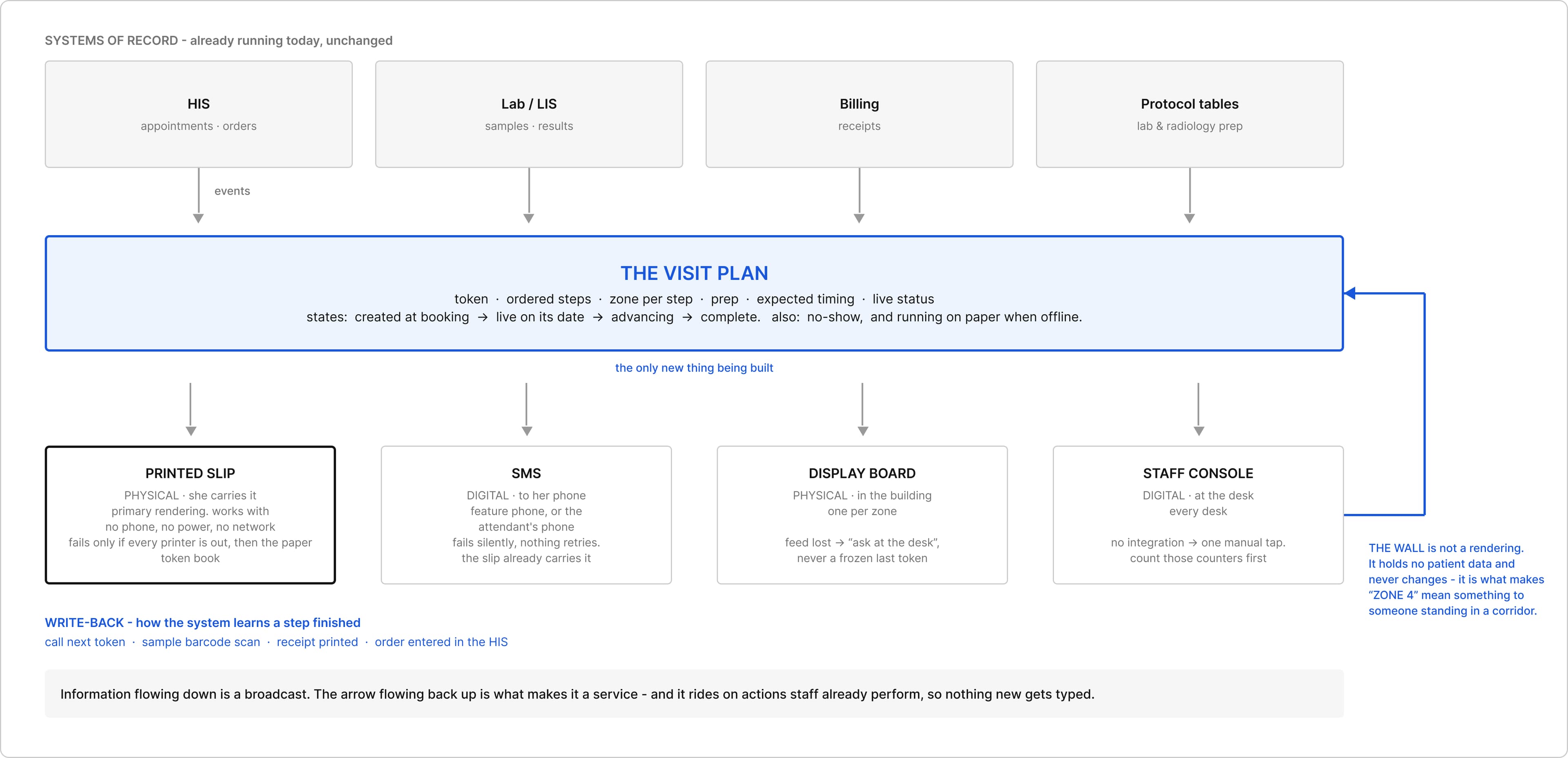
Every visit already has a plan. It exists in fragments across the HIS, the lab, billing and a clerk's head. The Visit Plan is that assembly, and it is the only new thing being built.
Design study, 2026Every counter is optimising itself. Nobody owns the sequence between them.
The morning everyone recognises.
You arrive early, because nobody can tell you when you will actually be seen. You queue at registration to find out you are in the wrong queue. Someone says ground floor; someone else says second floor. You are sent for a blood test and learn, standing at the counter, that you should not have eaten since last night — so you come back another day, and pay for the parking twice.
Nobody in the building is doing anything wrong. The registration clerk is quick. The nurse knows exactly who is next. The lab runs its samples in order. What no one owns is the sequence between them — so the patient carries the plan from counter to counter, in their head, asking one question at a time to whoever is nearest.
A design study, not a shipped product. No hospital partner, no fieldwork, no outcome data. My own mornings as a patient and as an attendant shaped how I read the problem; the evidence is published research, cited throughout; and every number is modelled and written so it can be challenged.
- 01One Visit Plan per visit — the ordered steps, the zone for each, the prep and the timing — assembled from records the hospital already keeps.
- 02Four renderings of it — a printed slip, an SMS, a display board, a staff console. The slip is primary, because it is the only one that works for a patient with no phone and nobody with them.
- 03One help desk at the door, not a gate. A patient who booked walks straight past it to her zone. It exists for anyone who arrives without a booking, without a slip, or with something wrong.
Two parts, two hospitals. Part one designs for this building: mixed literacy, many walk-ins, no guarantee of a smartphone. Part two takes the same Visit Plan to a hospital with a full HIS and LIS, and asks whether it can tell her when to leave home. Jump to part two ↓
Confusion is an ownership failure.
“The patient is doing coordination work the hospital could have done for them. That work is what fills the car park.”
The hospital already knows how a visit is supposed to go — the appointment, the order of steps, the prep required, the position in the queue, when the report lands. All of it exists, in the HIS or in a staff member's head. Almost none of it reaches the patient. That one gap produces all three complaints:
- 01Before arrival it costs a trip. Photo ID, current medicines and last visit's reports are knowable for every visit, and nobody sends them. Fasting is spoken by the doctor at the end of a consult — and a spoken instruction is not a record.
- 02During the visit it costs an hour. No one owns the sequence between counters, so the patient becomes the integrator.
- 03And that hour is what fills the lot. 180 spaces work for 1,200 visits only if visits are short.
Three complaints invite three features: a parking app, an indoor navigation system, a queue tracker. That is the trap. They are three symptoms of one cause, and two of the three would have made the cause worse by adding another thing for the patient to operate.
Five decisions, and what would make each one wrong.
- 01Attack coordination time, not clinical capacity
The doctor's hours are fixed; I am not designing to make consultations faster. Wrong if the wait is almost entirely doctor-queue — then the recoverable slice is small and the parking case collapses with it.
- 02Build nothing for parking
The first complaint anyone makes is the one I refuse to build a feature for. Allocation tools need slack to allocate. Wrong if a one-week count shows peak occupancy near 70% rather than saturated.
- 03Issue the token at booking, not on arrival
The move the evidence actually supports. Wrong if most patients book by walking in on the day — then there is no “before” to send anything to.
- 04Derive completion from calling the next patient
Nothing is added to the doctor's screen. Wrong if a counter has no call-next mechanism and no HIS event — that tap is genuinely new, and staff at capacity will stop doing it by week six.
- 05The printed slip is primary; digital is an accelerator
Nothing gates the service behind a device. Wrong if nearly every patient arrives with a working smartphone and the literacy to use it — then paper-first is over-engineered for this hospital.
- 01No new consultation revenue from shorter queues. The doctor is still the bottleneck.
- 02No reduction in doctor-queue wait. That is capacity, and capacity is not a design lever.
- 03No financial figure on what this recovers. The hospital's own data could produce one; inventing it would be worse than leaving it blank.
- 04No capture of the doctor's spoken aside. “Bring your old ECG” is not a record, and I have not pretended to solve it.
Waiting is coordination, not care.
- 01
- 02Which block is biggest, and is it recoverable?
Median wait at the registration window: 60 min for walk-ins against 15 min for online-registered patients, same institute [3]. The largest recoverable block — and why the token is issued at booking, not on arrival.
- 03Whose phone is it?
In an eye-hospital deployment, 12 of 19 patients had no smartphone or WhatsApp, and their attendants used the system instead [4]. The digital layer is designed for the attendant; the physical layer has to complete a visit for someone with neither.
- 04Does messaging change behaviour?
Two NHS trials, ~20,000 outpatients: missed appointments fell from 11.1% to 8.4% when the SMS named a specific cost; worded vaguely it did worse, at 9.9% [5]. The lever is specificity, not sentiment. The mechanism transfers; the wording does not.
- 05What does confusion cost staff?
301 US hospital staff: ~30 min a week each redirecting lost visitors, 44% had faced incivility doing it [6]. Wayfinding is a staff-load problem, not only a patient one — which is why signage and a staff script sit in the first phase.
- 06Is any of this proven, or am I inventing it?
India's ABDM Scan and Register: 25 crore OPD registrations at 30,800 facilities, public and private [7]. A QR-at-the-counter OPD token is proven at national scale. What is new here is the sequence and the prep, not the token.
The useful one is the third row. Walk-in and online-registered patients, in the same hospital, on the same days, facing the same doctors and the same volume, differed by 45 minutes at one window. Capacity was identical for both groups — so whatever explains that gap, it is not queue. That is the boundary I designed inside:
- 01Specialist time is fixed. I can only protect it from late arrivals cascading through a session.
- 02Lab, imaging and pharmacy are elastic but operational. I can smooth when demand arrives; I cannot add capacity.
- 03Registration, payment, sequencing, discovery are pure coordination. This is the recoverable time, and the only thing I designed against.
Same hospital, same doctors, same days — walk-ins waited 45 minutes longer at one window. Capacity cannot explain that.
The 45-minute gap is likely confounded by self-selection — people who register online skew younger and more literate. So I claim 30 minutes, not 45, and a within-hospital time study is the thing that would shrink it further.
Designed for the patient with no phone and nobody with her.
- The staying attendantWith an elderly or unwell patient all visit, walking between counters to discover the sequence. Their car is parked the whole time — so any parking gain has to come from car-minutes, not car-count.
- The unaccompanied patient, no smartphoneCannot complete a single step without asking a person. So the printed artefact must complete a visit on its own. Digital accelerates; it never gates.
- The dropping attendantNeeds to know when to come back. So status has to be readable from outside the building.
- Front-desk and counter staffAlready at capacity. Anything added at a counter must remove more work than it creates — the constraint that decides whether the live layer survives a real shift.
I built nothing for parking.
Modelled from the hospital profile: 1,200 visits a day, roughly half in a four-hour peak, is about 150 arrivals an hour. At 40% by car that is ~60 patient cars an hour, and at a two-hour average dwell, ~120 parked at any moment — before staff, inpatient visitors, ambulances and vendors. Against 180 spaces. Stress-tested at a pessimistic 30% car share it still lands near 150. The lot is tight to saturated either way, and a slot-booking layer on a saturated lot moves the queue from the ramp into an app.
- Parking slot-booking
Needs slack the lot does not have, and adds a no-show failure of its own.
- Indoor turn-by-turn navigation
Zone-numbered signage solves it for the price of a print run.
- A native app as the primary channel
Excludes the patient this design exists for.
- New parking bays
Highest cost, longest lead time, and does not touch the cause.
- Work on car-minutes, not car-count. 60 cars an hour at 1.5 hours of dwell instead of 2 is ~90 cars in the peak pool instead of ~120 — not 30 empty bays, but it absorbs the overflow that circles.
- Faster registration only moves the wait to the chair. The saving converts to dwell only if arrival is retimed with it — token-at-booking and staggered arrival windows are one mechanism, not two features.
- Kept as parking work, none of it capex: staff parking moved off-site, a drop-off protocol for attendants who can leave, staggered windows.
If a one-week occupancy count comes back near 70%, this call is wrong and the allocation tool is the right build.
One plan, four renderings. Nothing new gets typed.
Every visit already has a plan. It exists in fragments — the appointment in the HIS, the prep in the lab's protocol document, the sequence in a clerk's head, the report turnaround in the LIS. Nobody assembles it, so nobody can hand it to the patient. The Visit Plan is that assembly: one record per visit holding the token, the ordered steps, the zone for each, the prep, the timing and the live status. It is the only new thing being built.
It renders to whatever the person in front of you can actually receive. The printed slip is the primary rendering, not the fallback. Information flowing down is a broadcast. The arrow flowing back up — call next, sample scan, receipt, order entry — is what makes it a service, and it rides on actions staff already perform.
- Arrive early
- Queue at registration~60 min for walk-ins
- Ask for directionscounter by counter
- Reach the lab unpreparedate breakfast
- Come back another dayparking twice
Every counter works. The sequence between them is carried in the patient's head, one question at a time.
the patient is the integrator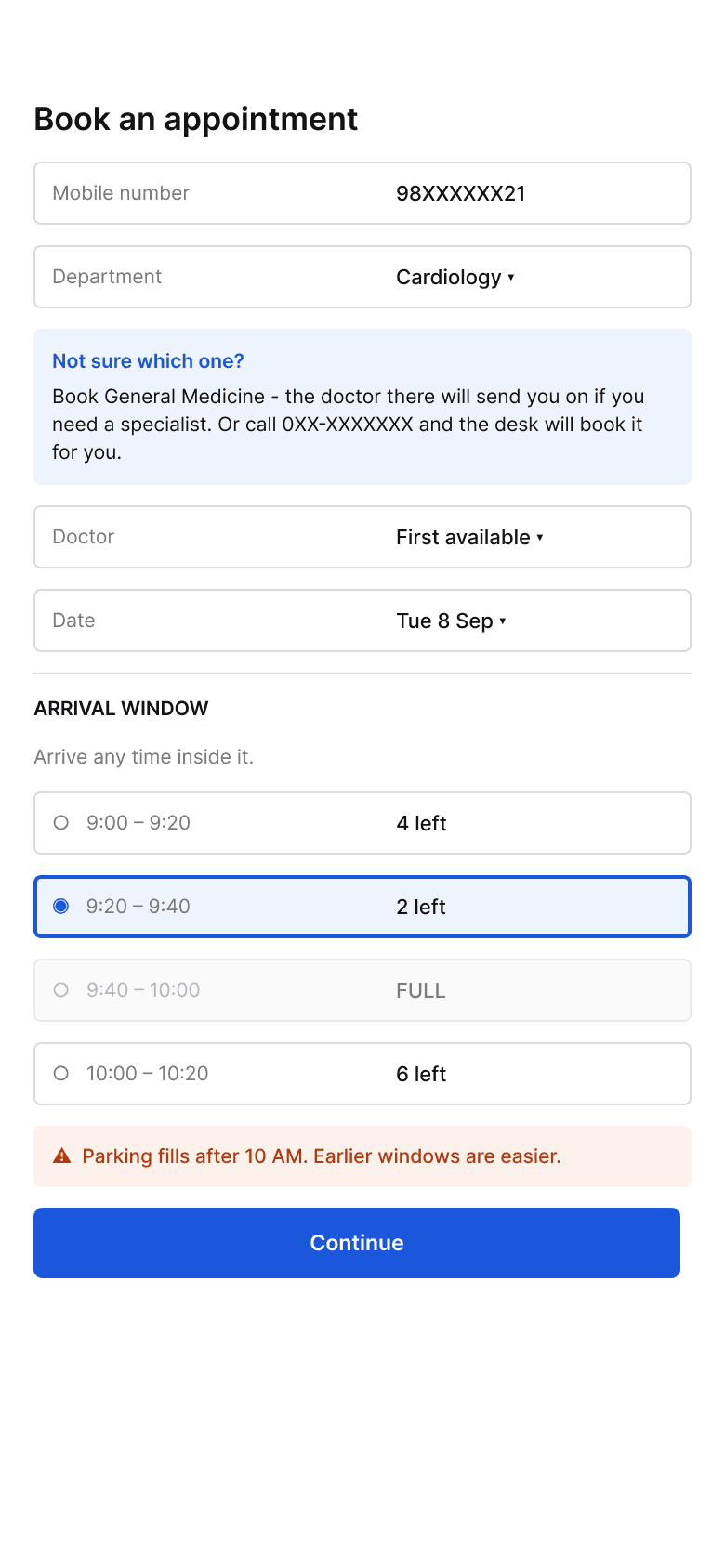 1 · Book a windowThree of four fields are prefilled. She picks a 20-minute arrival window, and sees that parking fills after 10.
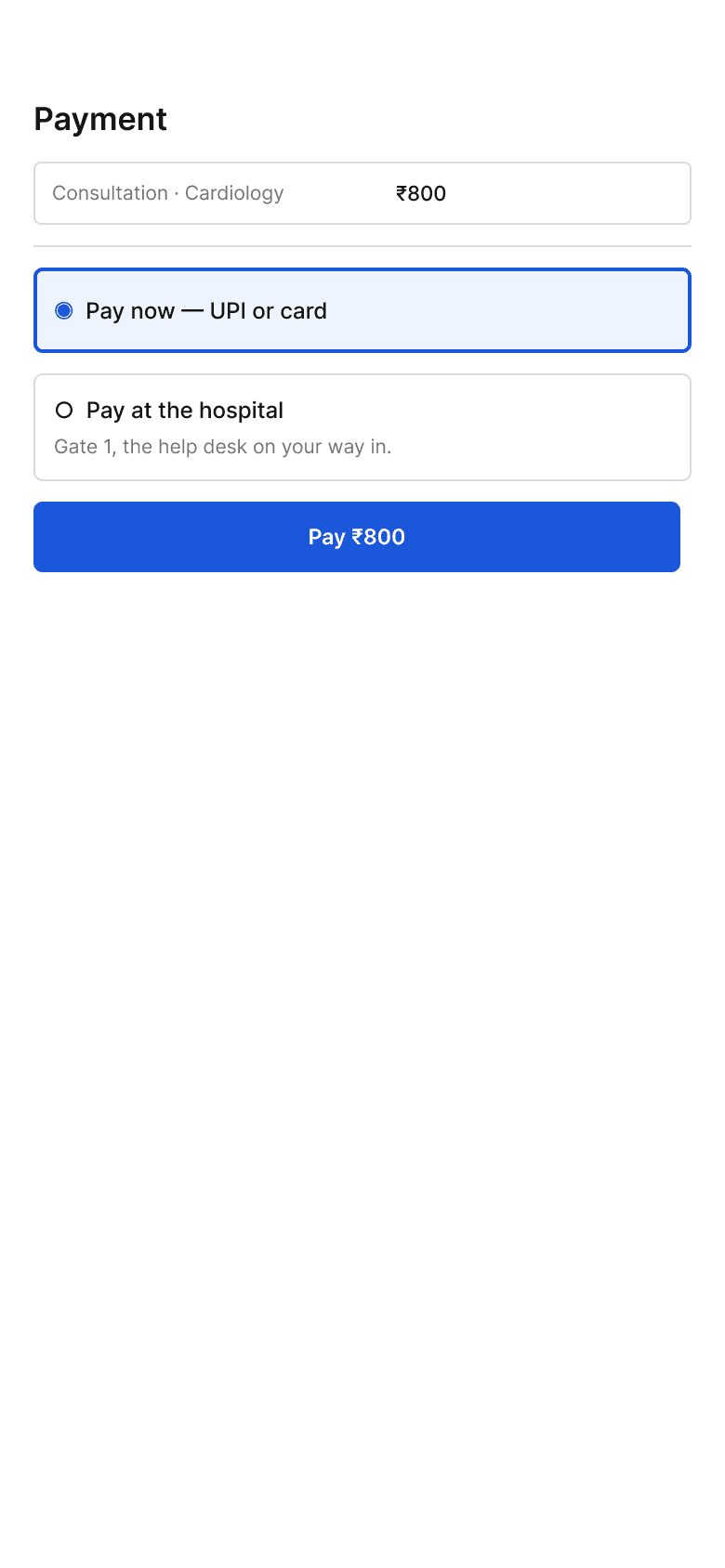 2 · Pay now, or at the gateBoth are full options. Paying later just becomes step 1 on her slip.
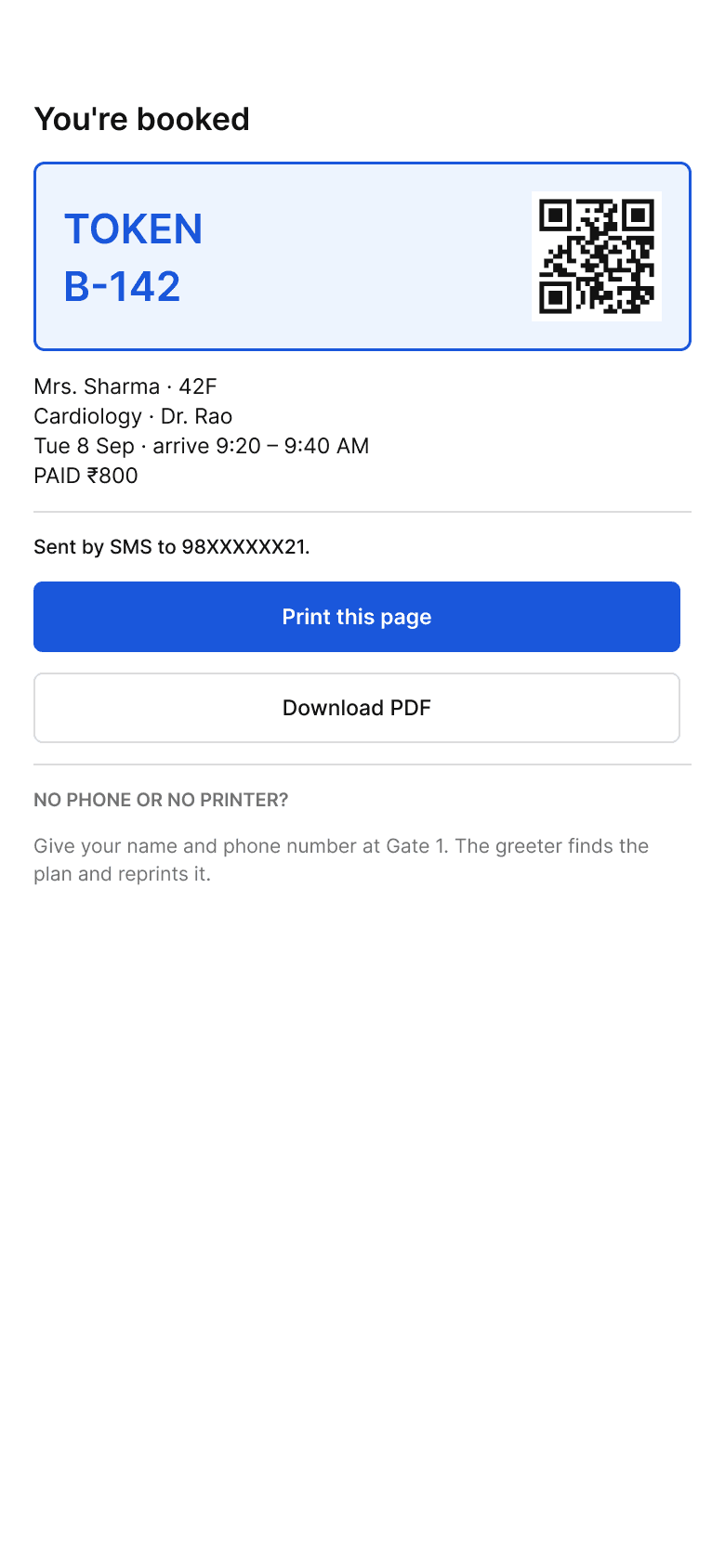 3 · BookedB-142 is issued now, not on arrival. The QR is for staff; the code is for people.
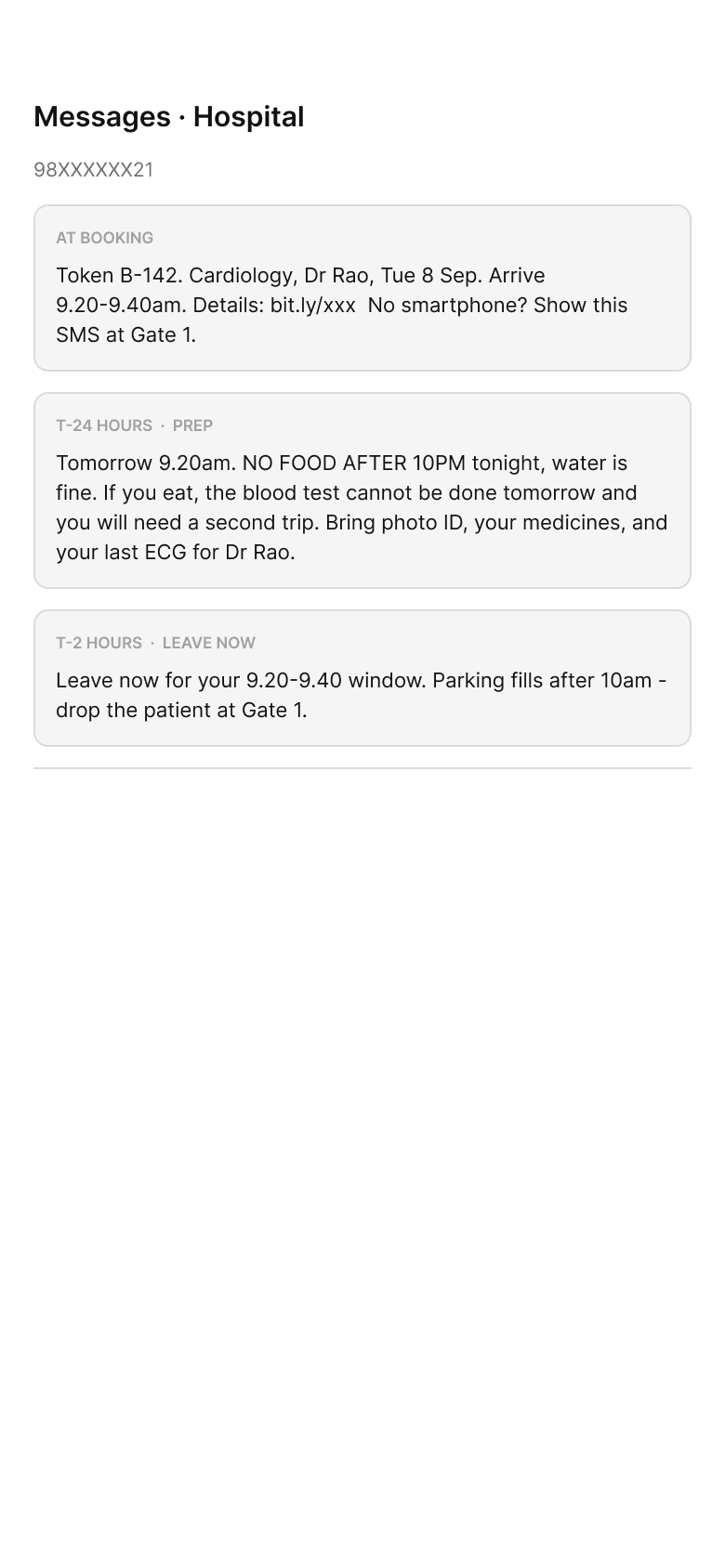 4 · Before the dayAt booking, prep the night before, and a leave-now two hours ahead.
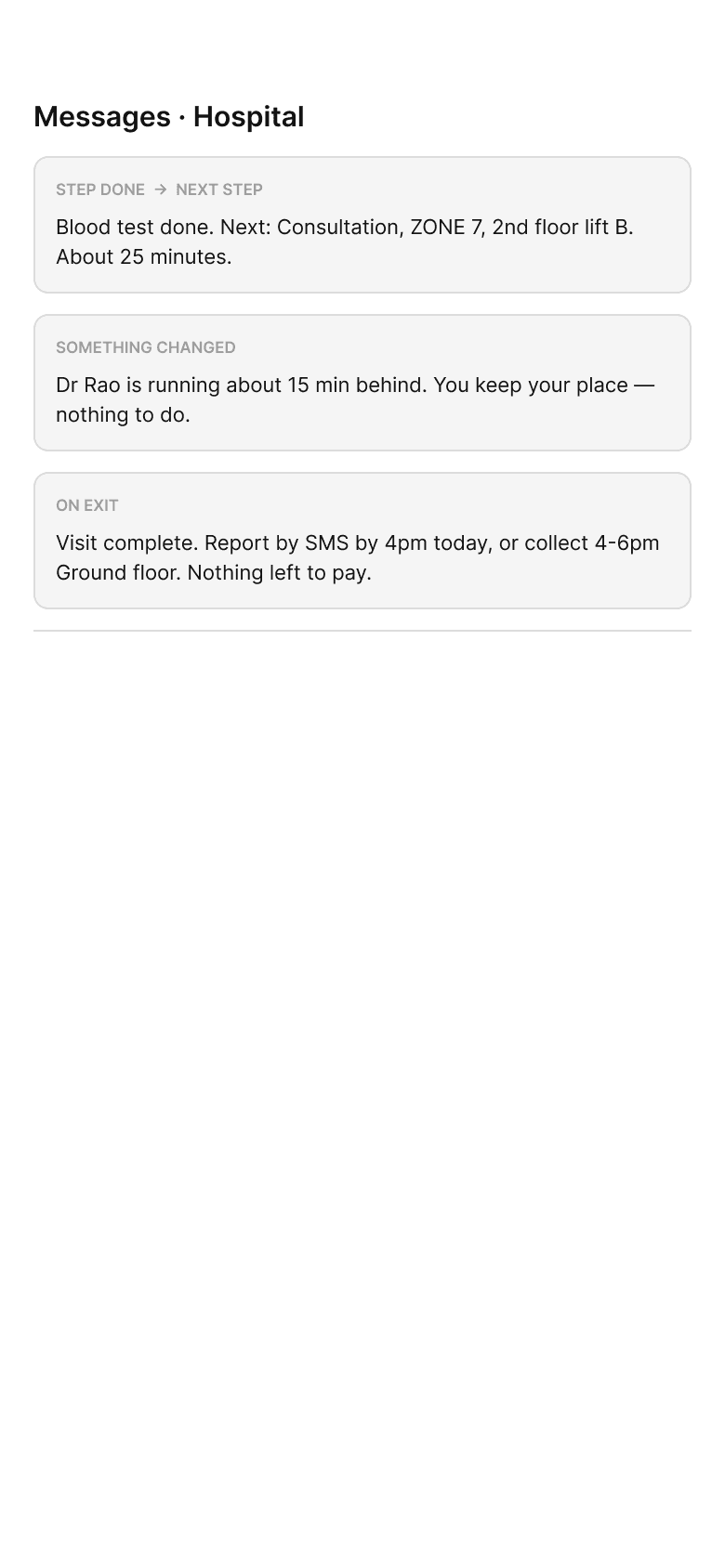 5 · During and afterHer next step after each one finishes, a delay if there is one, and when the report lands.
Mrs Sharma, token B-142, booked for a cardiology consult with a blood test first. Nothing to install: the same Visit Plan reaches her as a booking page, a few SMS and a printed slip — and her son's phone gets the same messages if his is the number on the booking.
Follow one token from the gate to the pharmacy.
She arrives with the plan already in her hand. The paper is the part that never fails: the slip carries the whole visit, and if the system goes down, the desks switch to pre-numbered books in the same format.
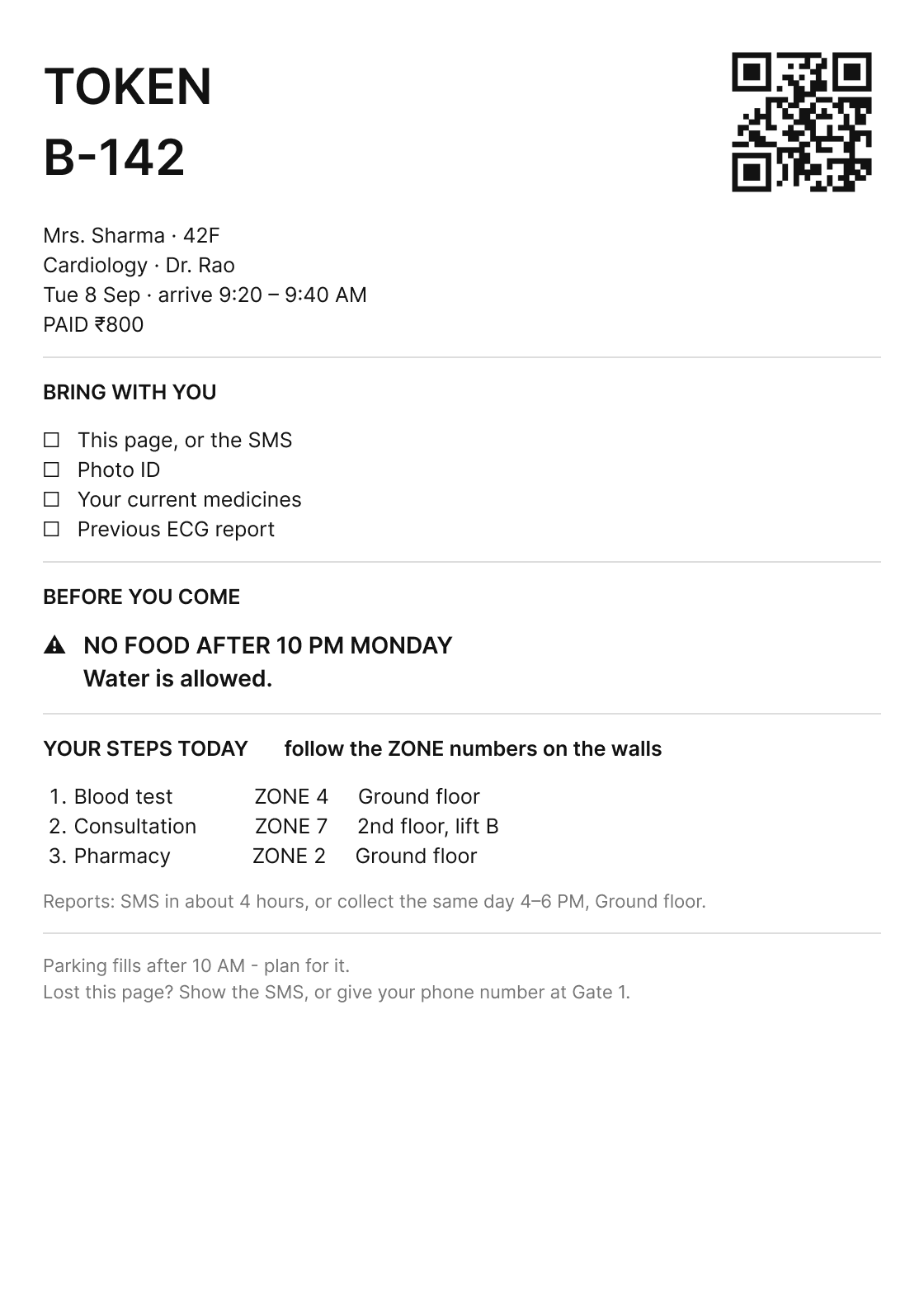
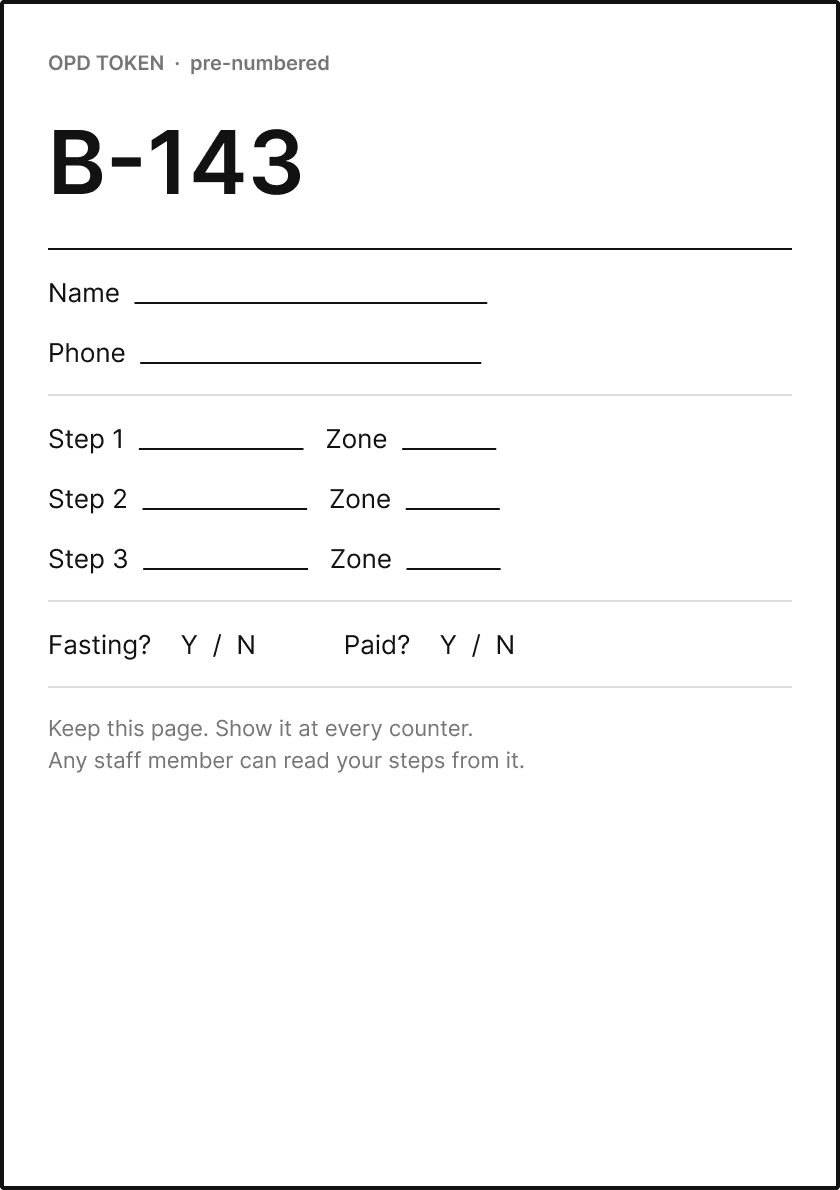
9:28, Gate 1. She left her slip at home. Most booked patients walk straight past this desk; she stops because she has nothing to show.
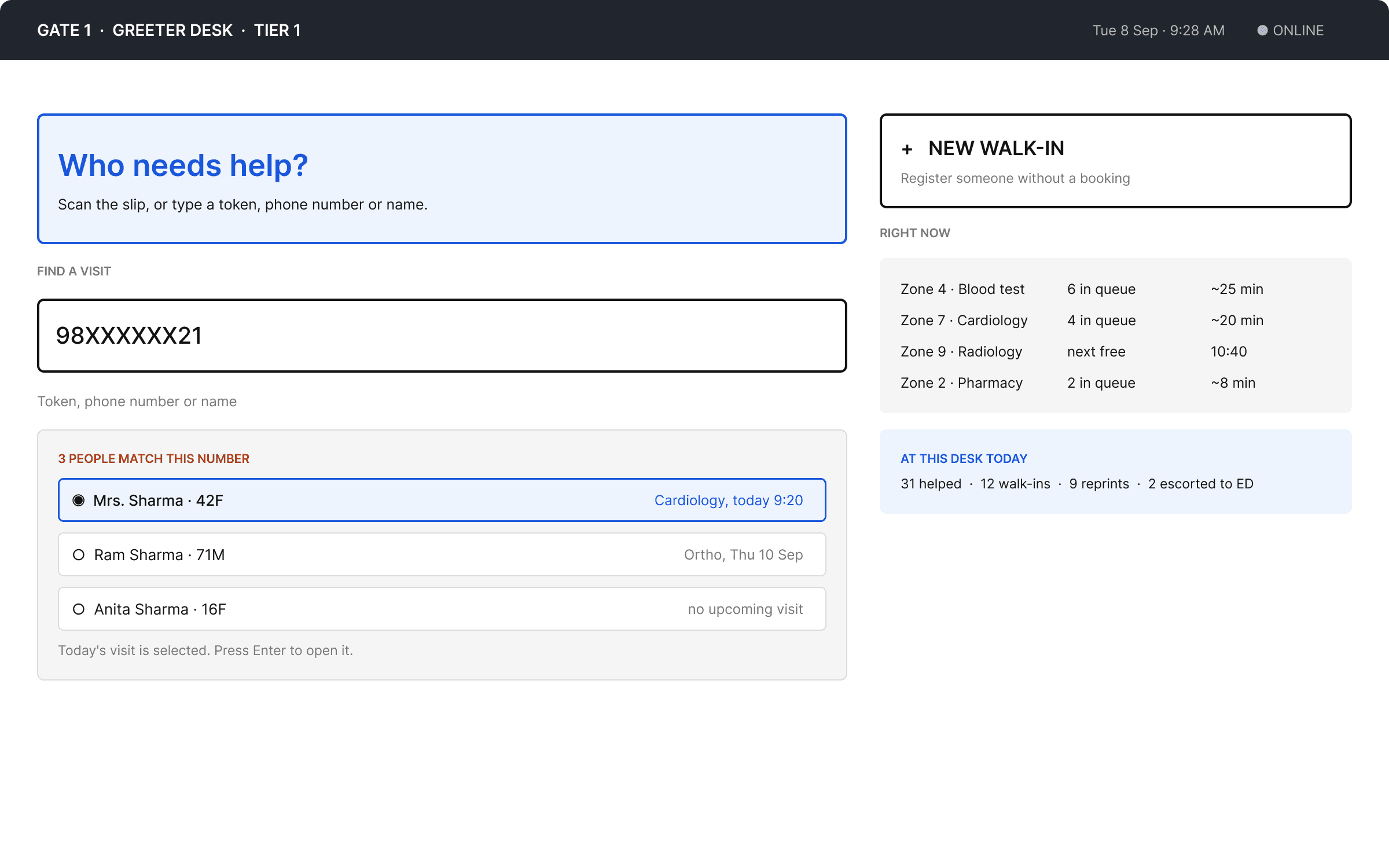
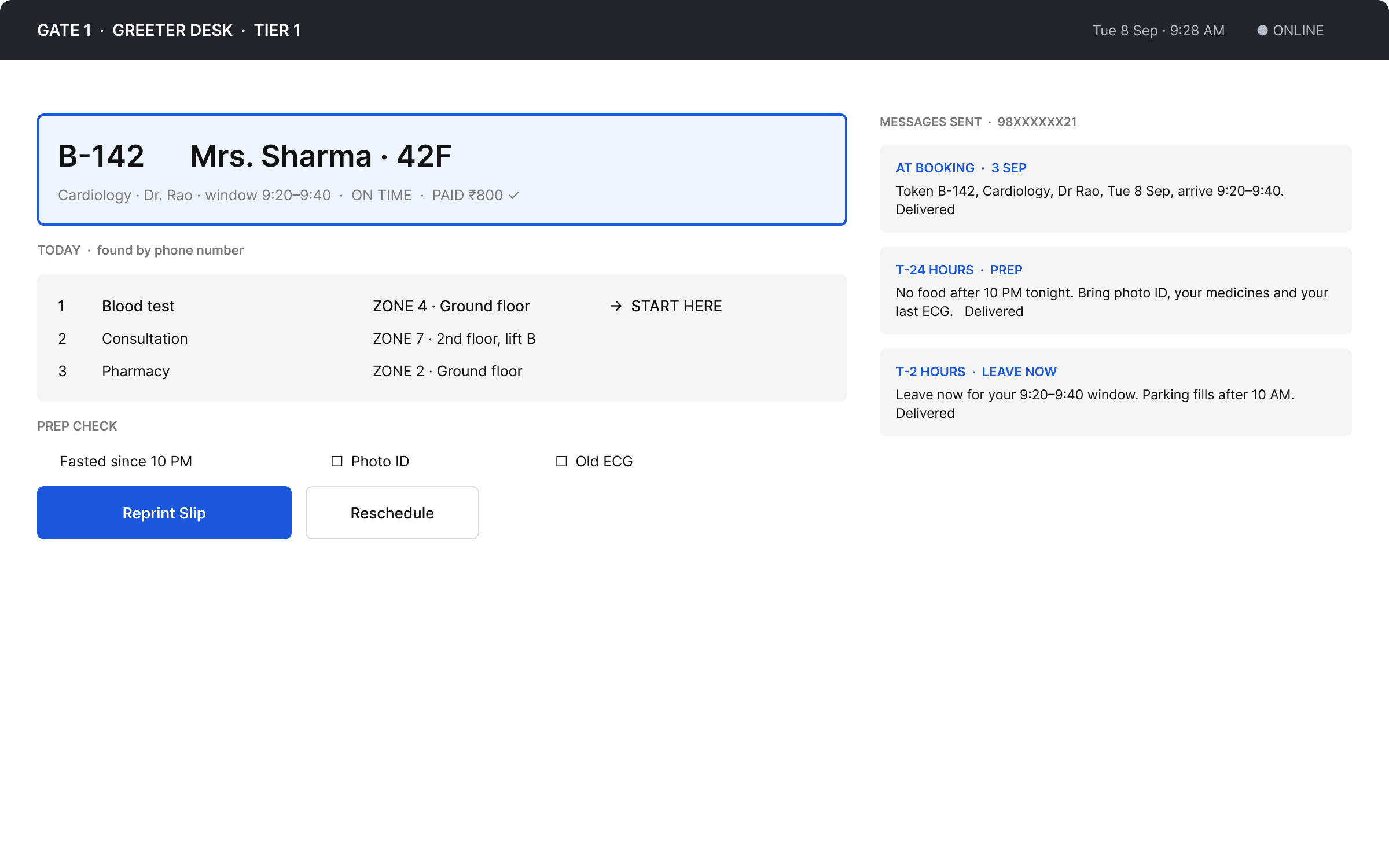
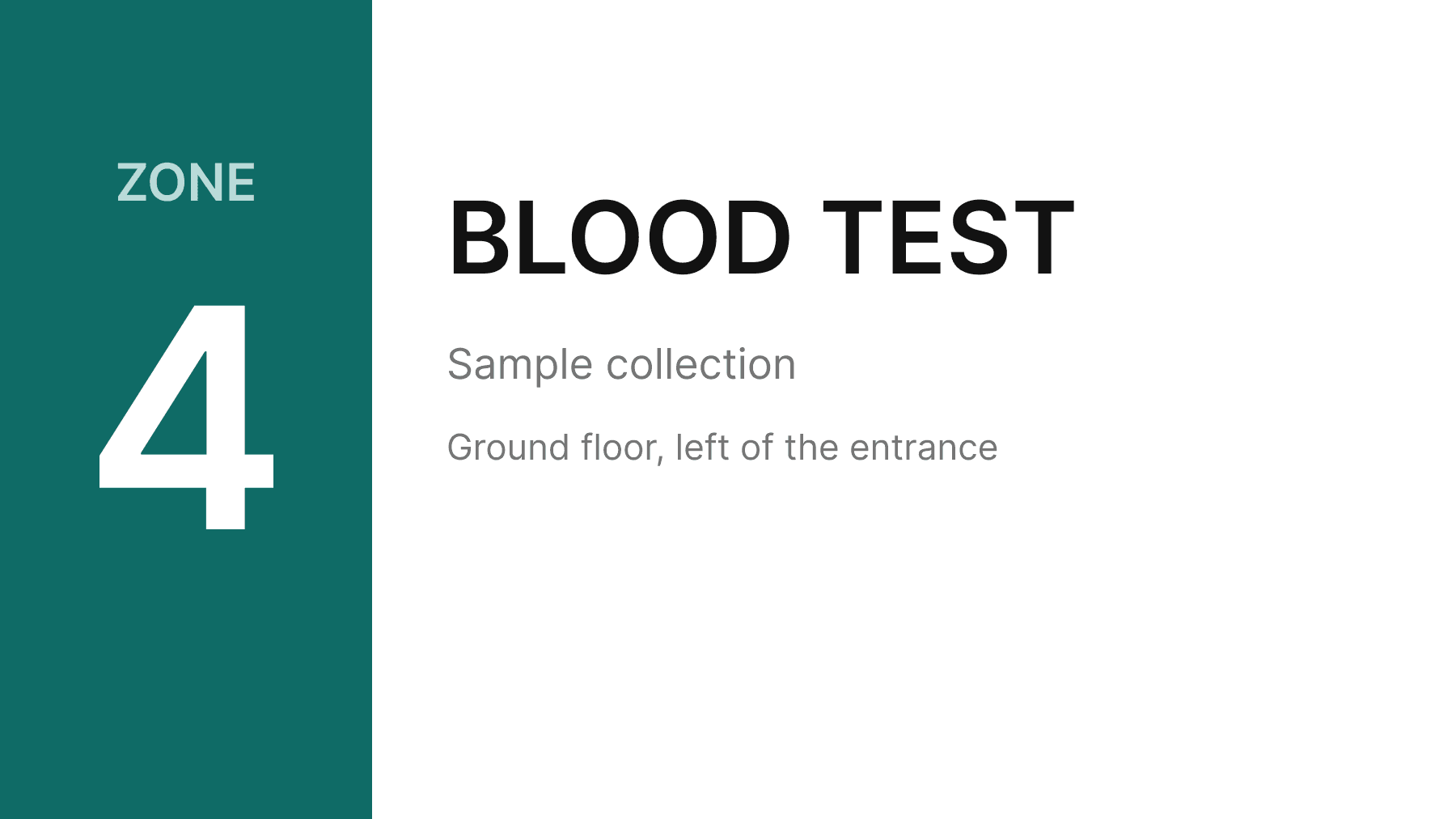
9:53, Zone 4. She is called for her blood test. The clerk asks the one question they have to ask before taking a sample anyway.
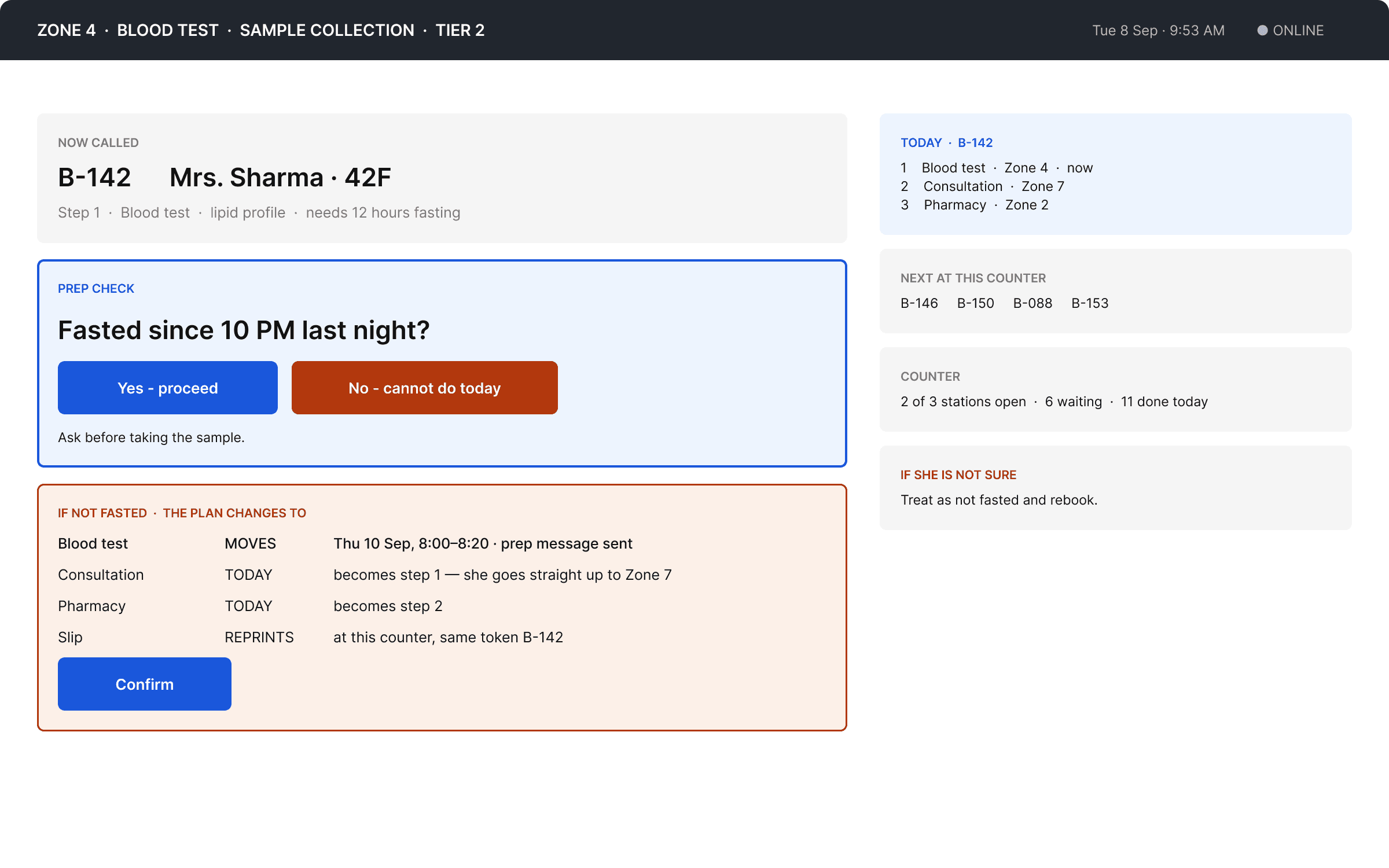
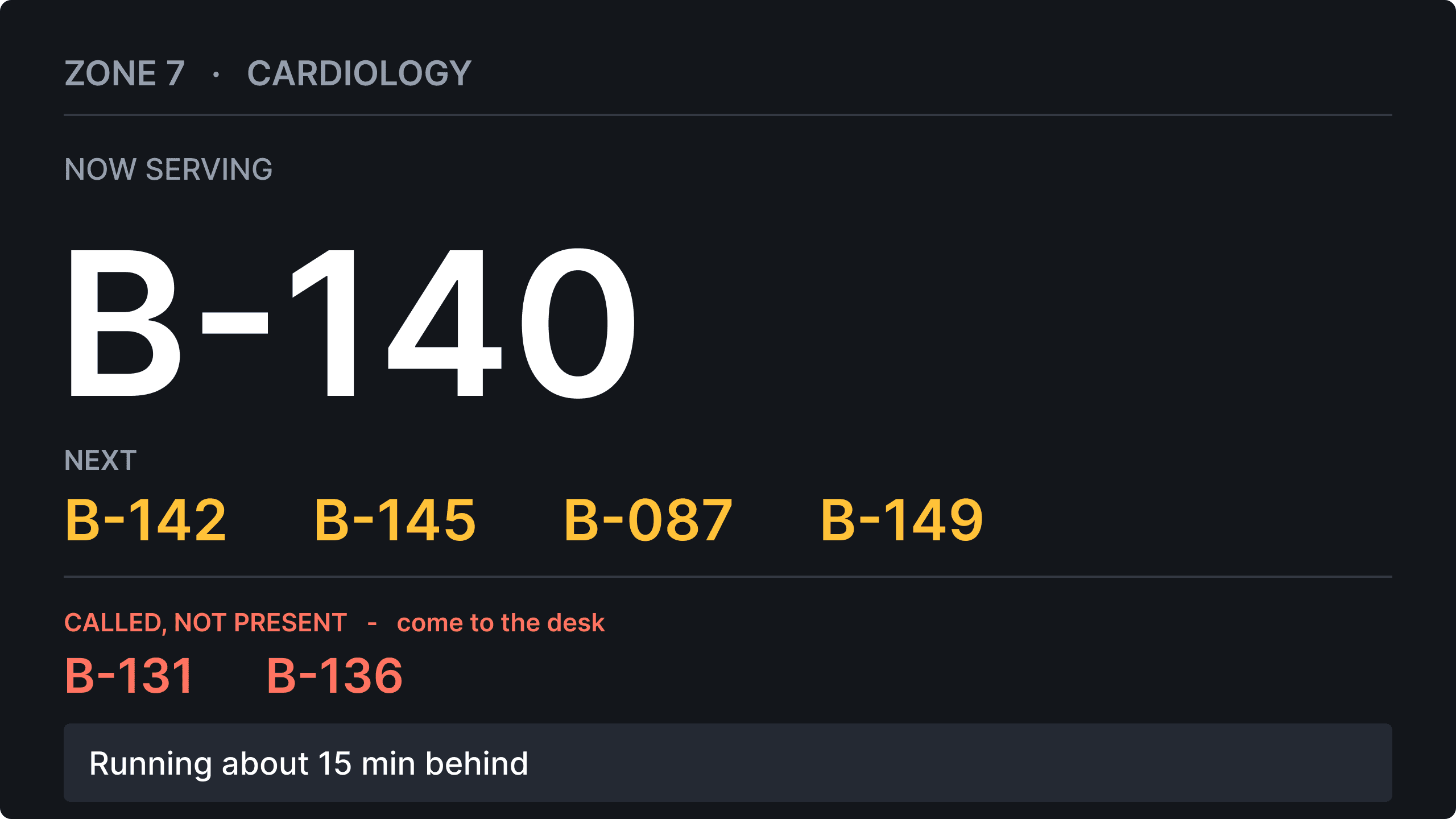
Zone 7, cardiology. She fasted, so the sample is taken and the barcode scan moves her plan on. Upstairs, the board already shows B-142 next, and Dr Rao is running about 15 minutes behind.
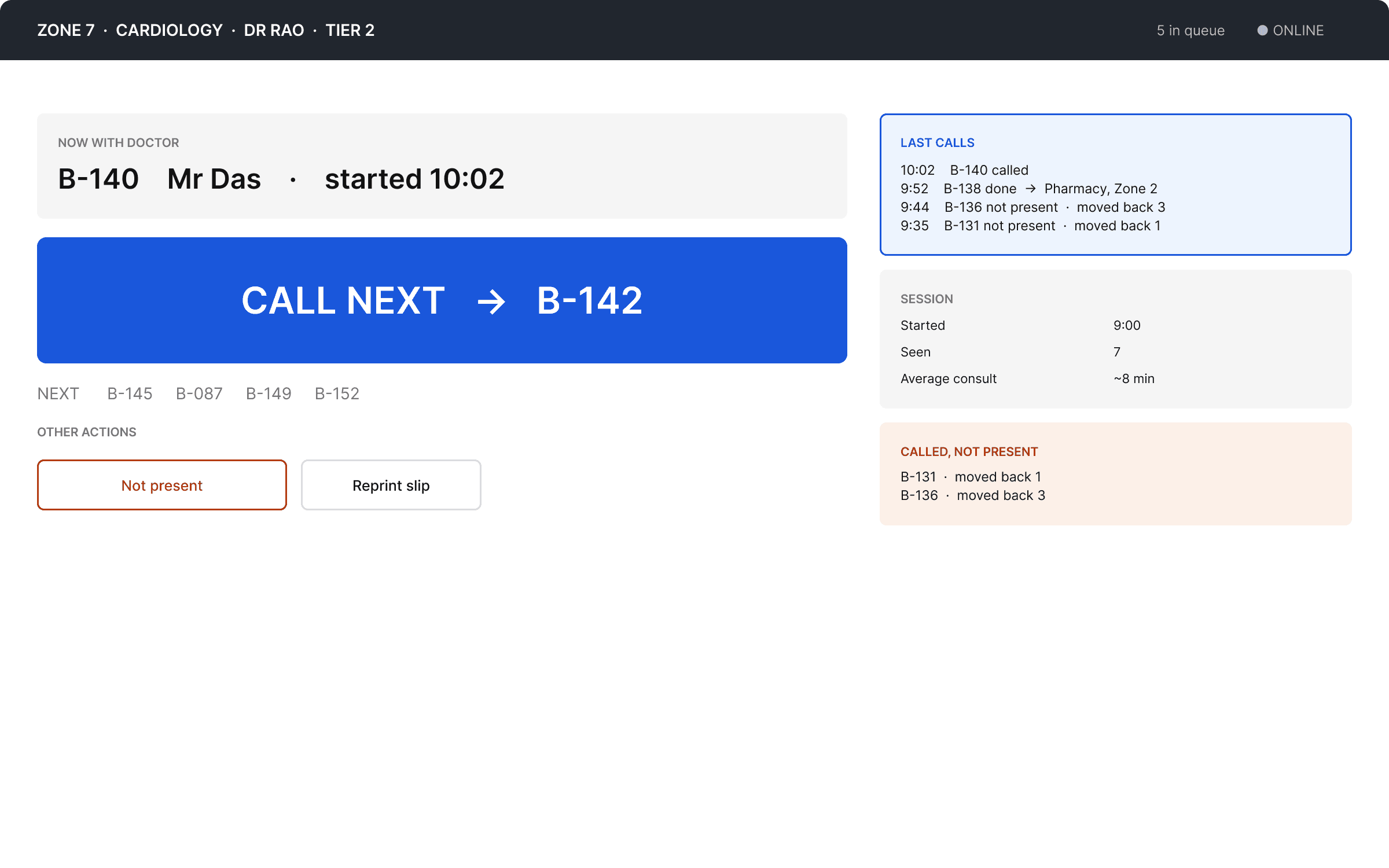
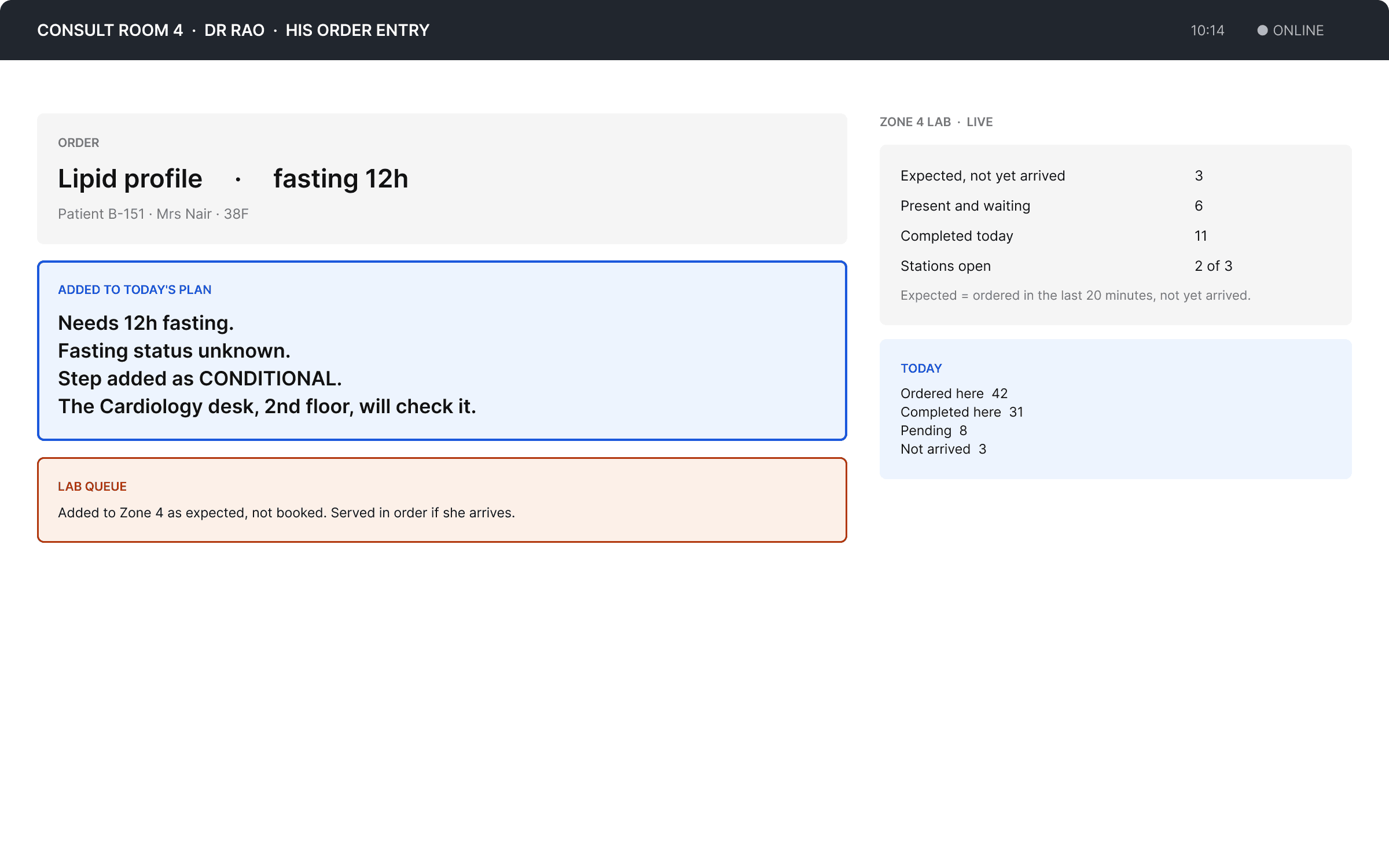
10:14, a consult room down the corridor. The doctor orders a test for another patient, B-151, who booked a consultation only.
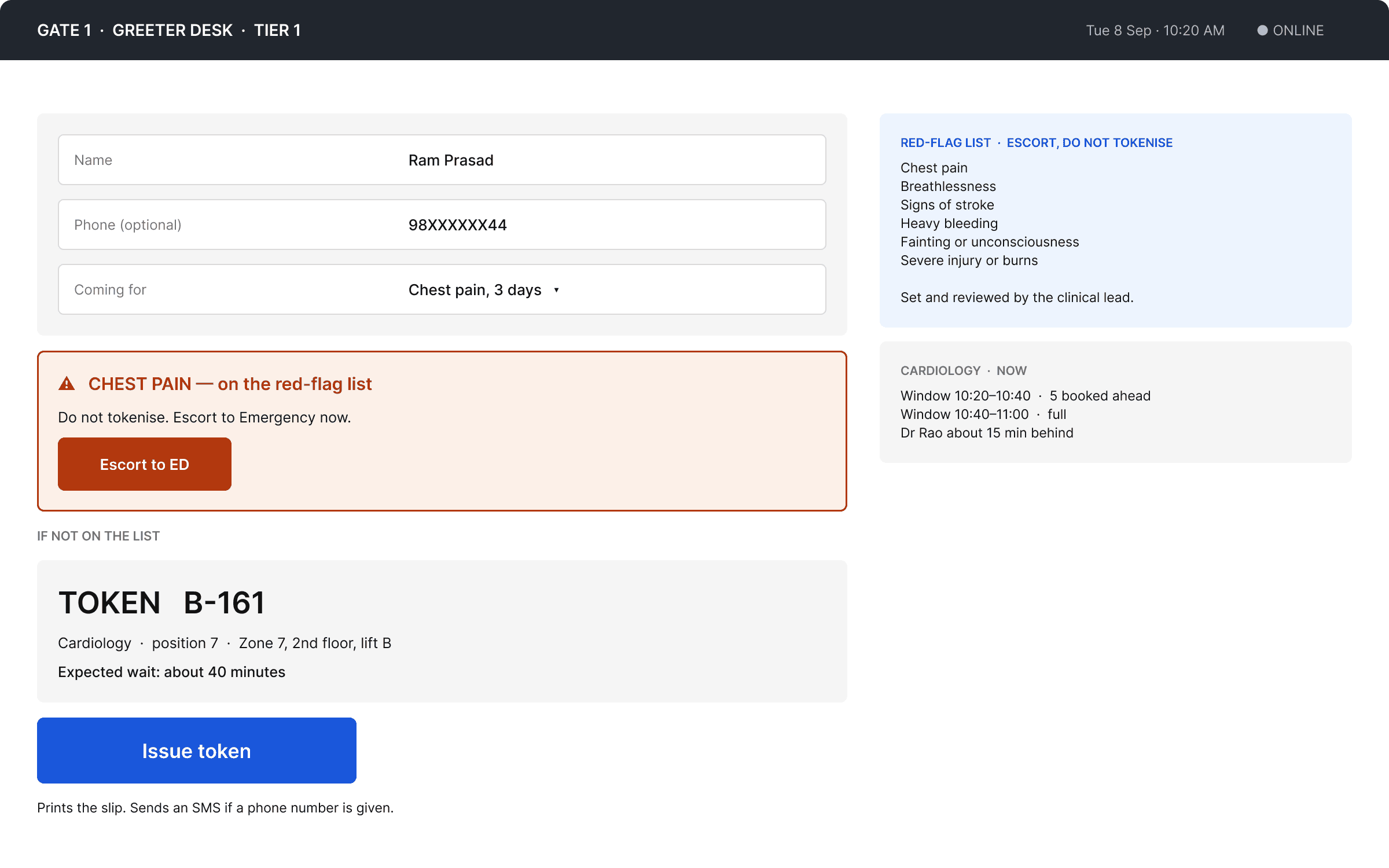
10:20, back at Gate 1. A man walks in without a booking.
Three numbers, three jobs.
The most load-bearing decision in the system was keeping three numbers apart:
Zone numbers go on the wall. Step numbers go on paper.
The wall cannot carry steps, because steps are personal. The token cannot carry a department, because the patient moves through several. A patient who can count follows her step list; one who cannot read still matches the 4 on the paper to the 4 on the wall.
- 01Identity
Any desk scans it, types it, or finds it by phone number, and has the whole plan.
- 02Privacy
It is what appears on the public board instead of a name. A name beside a department is a diagnosis, in a room full of strangers.
- 03Sequence
Each zone holds its own queue of tokens. The same token holds a place in Zone 4, then later in Zone 7.
- 04Redundancy
A human-readable code and a QR carrying the same value. A dead scanner, a flat battery or a torn corner never stops a visit.
One letter and three digits. The letter is the day, cycling, so a short range can be reused without collisions — and short matters, because it is read aloud, typed under pressure, and remembered by someone who is unwell. Nothing in it reveals how the patient got there. Prefixing walk-ins would make a second class visible on every board and to every clerk — discrimination by typography.
- Issued at booking
- Live on its date
- Already in the queue
- Called
- Advances
- Reprints safely
- Offline
- Ends at exit
The consult is a production step.
The lane is set by what the system knows at booking — not by whether the patient is new.
At 10:14 the doctor orders a lipid profile. What happens next, in order:
- 01The doctor orders
The same HIS order entry as today — no new screen, no new field, nothing extra to type.
- 02The system resolves the prep
From the lab's own protocol table: this test needs 12 hours fasting.
- 03It checks what it knows — and admits what it doesn't
On a consult-only visit nobody told her anything, because no test existed thirty seconds ago. Fasting status is unknown, and the system does not pretend otherwise.
- 04The step is created as conditional
In plain words, on slip and SMS: “Blood test · Zone 4 · needs 12 hours fasting. If you have eaten today, tell the Cardiology desk on the 2nd floor before you go down.” The desk is named, never implied.
- 05The condition is resolved at the first opportunity
The desk outside the consult room may ask as it hands over the slip; if not, the Zone 4 clerk asks when she is called — which they must do before taking a sample anyway. Her consultation and pharmacy steps are untouched.
- 06The plan re-renders everywhere, same token
Only the step list changes, so an old slip and a new slip can never be read as two patients.
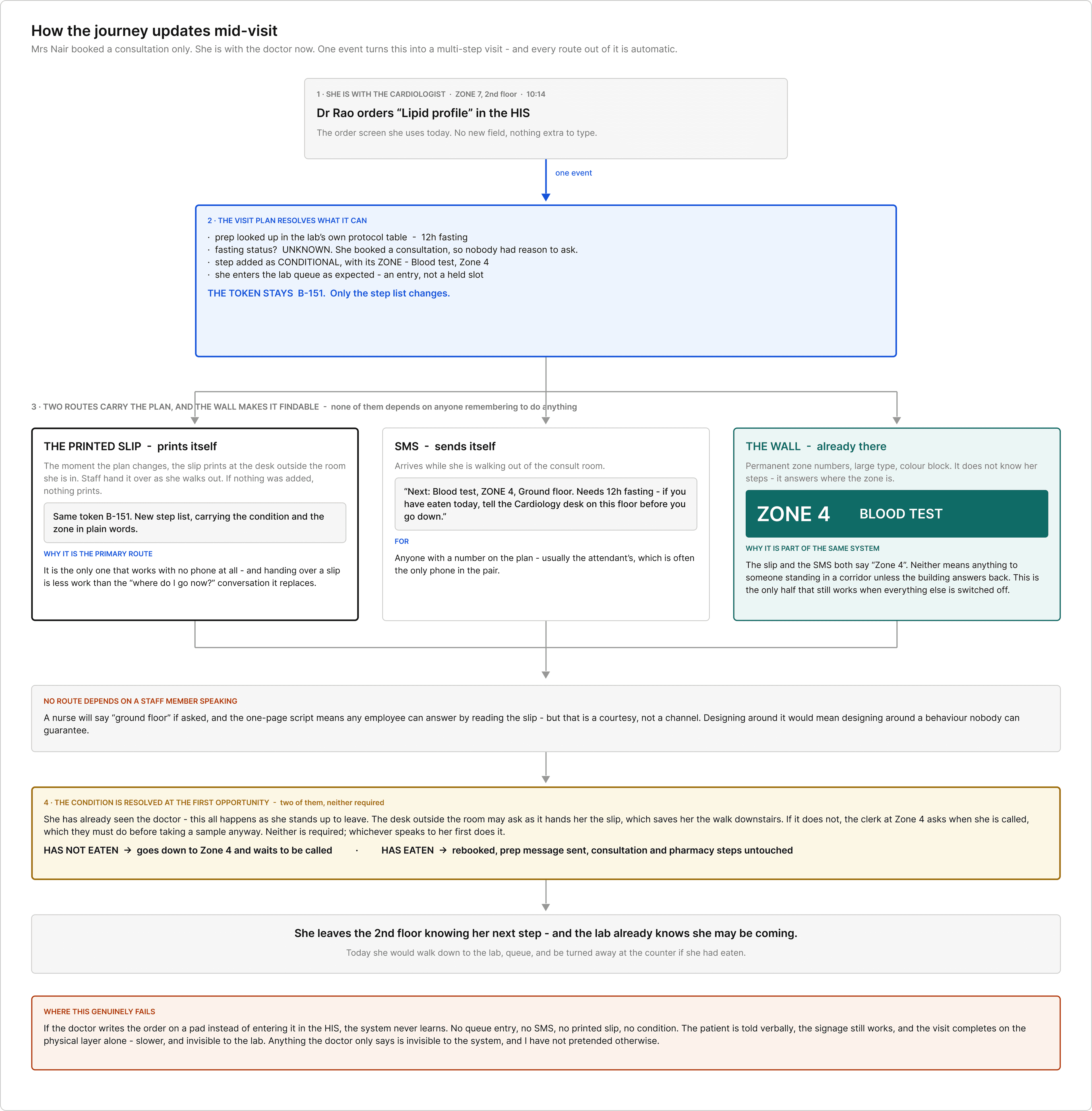
No slot is held. Patients routinely take a prescription to a cheaper outside lab, and that is their right. So the order creates an expected entry, not a reservation — the lab sees demand 10–20 minutes ahead without locking capacity for anyone who may not come. Same reason I refused to hold parking for someone who might not turn up.
- 01The person tells her the next step. The slip carries the whole visit — pharmacy, the 4 pm report, that she has already paid.
- 02Speech does not travel. The instruction is needed ten minutes later, on another floor, at a counter staffed by someone who was not in that conversation.
- 03The person told is often not the person who remembers. The attendant is parking the car. The slip moves between them; the sentence does not.
Not claimed: cutting dwell does not reduce lab volume — it raises it, because fewer patients abandon their prescribed tests. The design makes that load predictable rather than smaller, and I would rather price it than hide it. And it does no symptom routing: choosing a specialty from a symptom is a clinical decision, so an undiagnosed complaint books General Medicine, or the booking clerk routes it — exactly as the hospital already works.
Completion is derived, never entered.
- 01Consult finished
The clerk presses call next. Calling the next patient is the previous patient's completion. New work: zero.
- 02Lab step finished
Sample barcode scan at collection — samples are already barcoded. New work: zero.
- 03Payment taken
The receipt at billing, which is also what releases the next step. New work: zero.
- 04Test ordered mid-consult
The order written in the HIS. New work: zero.
- 05Report ready
Result released in the LIS. New work: zero.
- 06A counter with no integration
One tap on the console — the fallback. Count how many such counters exist before promising live status for them.
When no signal arrives, the plan reads “in progress” and never invents a time. A wrong “five minutes” that becomes forty destroys trust in every message after it. Silence degrades gracefully; a fabricated number does not.
There is no “mark complete” button anywhere. A button is what gets skipped at 11am on a busy Monday.
Order is not advice. It is enforced.
- 01You cannot be called before your window opens — so arriving early gains nothing.
- 02Within a window it is booking order. Arrive after it closes and you join the current window at the back.
- 03You cannot be called for a step until the step above it on your slip is complete.
- 04A walk-in joins the current window behind its booked patients. Booking buys a place; walking in buys the gaps.
- 05Nothing checks anyone in. Absence is discovered by calling, not by tracking arrival.
- 011st miss — back one position
Catches the patient who simply did not hear it. They are sitting right there.
- 022nd miss — back three positions
Toilet, water, a call outside. Buys 10–15 minutes. Positions, not minutes, so it self-adjusts to how fast the session is running.
- 033rd miss — held, out of the queue
They come to the desk to rejoin, keeping their token and their prep. The board shows CALLED, NOT PRESENT, so nobody has to ask.
Payment is a step on her slip, not a checkpoint at the door.
Removing the registration counter removed the thing that collected money — a patient choosing “pay at the hospital” could be seen and go home. Putting a payment gate back would be the registration queue wearing a different badge. So payment is step 1 on her slip, with a place, exactly like a blood test. By the ordering rule she is not callable until the receipt prints. Nobody stops her; she is simply not in that queue yet. And payment never touches the red-flag path.
Paper, walls and a help desk carry the load.
The greeter is a help desk, not a gate. A booked patient who has her slip and has paid walks past it. A desk everyone must pass through is a registration queue with a different name. Of ~150 arrivals an hour, if ~20% are walk-ins and ~10% arrive with a problem, about 45 reach the desk. At ~75 seconds each, that is 56 minutes of work in a 60-minute hour — one greeter, fully loaded, with a second roving one as the valve at peak.
- 01A short, fixed list of complaints that mean do not give this person a queue position — escort them to Emergency now.
- 02A list, not judgement, because the greeter is non-clinical. The walk-in screen's “coming for” field does the matching; a laminated card is the offline fallback.
- 03Written and owned by the hospital's clinical lead, not by me. Limits stated: it catches only what is on it, it produces false positives in the right direction, and if nobody owns it, it rots.
- 01No smartphone
The printed slip carries the entire visit. Lost: nothing — this is the primary path.
- 02Phone dies
Any counter reprints from the token code, or from name and phone. Lost: push notifications.
- 03System or network down
Pre-numbered paper token books, same format, ranges pre-allocated per desk. Lost: live status only; sequence is preserved.
- 04Slip lost, no phone
Name lookup at the greeter desk, reprinted in about fifteen seconds. Lost: nothing.
- 05Patient cannot read
The zone number and colour block match the slip; the token is announced aloud by the system. Lost: nothing.
- 06Unaccompanied elderly patient
The greeter walks them to step 1; every step is readable off the slip by any employee. Lost: nothing.
- 07Unbooked walk-in
Red-flag check, then a token behind that window's booked patients, with an honest wait. Same token, same board, same sequence.
The digital layer can fail completely and the service still works, just slower.
The design got smaller and more honest every time.
- 01The wall said STEP 2
I designed step-numbered signage so slip and wall spoke one language. But the same blood test is step 1 for one patient and step 2 for another — a static sign cannot be both. Fix: zone numbers on the wall, step numbers on paper.
- 02The greeter was a gate — three times over
First, every patient stopped to have their token activated: the registration queue rebuilt. Then a scan at the first zone — but booking had already put her in the queue, so the scan did no work. Final: no check-in of any kind. Absence is discovered by calling.
- 03Nothing collected the money
Removing registration removed payment, and I missed it. A checkpoint at the door was the old queue with a new badge. Fix: payment is step 1, printed with a place, enforced by the ordering rule.
- 04A number on a public board with no arithmetic behind it
A board read “running about 10 minutes behind.” Nothing computed that figure. Fix: a session-level delay, never a per-token time — and only once call-next data makes it mean anything.
None of these were caught by a usability test. They were caught by asking what a piece of the system actually knows at the moment it has to speak.
Most of the value before a line of code.
- 01Phase 0 · weeks 0–8 · near-zero engineering
Staff parking moved off-site. Zones renamed and numbered, with signage. Staggered windows with the no-early-call rule. Prep messages through the existing SMS gateway. Paper token books, a greeter desk, a one-page staff script, a laminated red-flag card, tokens announced wherever a speaker exists. A print run, a scheduling rule, a naming decision and one staffing decision.
- 02Phase 1 · about a quarter · small team
Token at booking, the printed slip and its automatic reprint, pre-payment, the greeter console, display boards. Reads appointments from the HIS; writes only the Visit Plan.
- 03Phase 2
HIS and LIS event integration for live status — read appointments and order codes, subscribe to four event types. An integration project, not a rewrite, and I would say so rather than imply otherwise.
With half the time and engineering, I would cut live status first. It makes the service feel better, not work.
Who pays, and what keeps it alive. The hospital, from the OPD operations budget rather than IT capex — an operations line survives a budget review a capital project does not. The value is in hours already paid for: prescribed tests completed in-building instead of abandoned, prep-dependent slots not burnt, ~30 cars out of the peak pool, and directional questions moved off clinical staff. Running cost is modest and known — four to six SMS a visit, paper, displays — and the real recurring cost is one greeter, argued for on its own merits. The metric that keeps it funded is the registration queue at peak: visible at the front door, reportable every week.
If she lives twenty minutes away, why is she waiting two hours?
Part one takes the coordination out of the visit. It does not take out the waiting for the doctor — that is capacity, and I said so. But once the Visit Plan exists, the hospital knows something it has never been able to tell anyone: how fast today's queue is actually moving. A patient who lives twenty minutes away and spends two hours in a chair could spend an hour and forty minutes of that somewhere else — if the hospital could tell her when to leave.
This part is designed for a different building: a private multi-speciality with a full HIS and LIS, where most patients book ahead and already use the hospital's app. That changes what is possible. It does not change what is hard.
Hospitals already do, and patients still arrive at 8 for an 11 o'clock slot. They are not irrational. Arriving early costs hours; arriving ten minutes late can cost the day, the wages and the attendant's day off. That asymmetry is a payoff, and no amount of information changes a payoff.
An advised arrival is guaranteed. If the system told you to come and you came, you cannot lose your place — the hospital made the prediction, so the hospital carries the cost of being wrong.
Only if location buys something. It never buys queue position. Opt-in, never the only path, and withdrawing it degrades the patient's experience — never their place.
- Window says 9:00
- Arrive at 8:4514 people, 11 chairs
- Doctor starts at 9:3838 min late, unannounced
- Called at 10:0580 min in a chair
- Nine-minute consult
She came early because coming early is rational today. Nothing in the booking system knew the session would start 38 minutes late.
eighty minutes for nine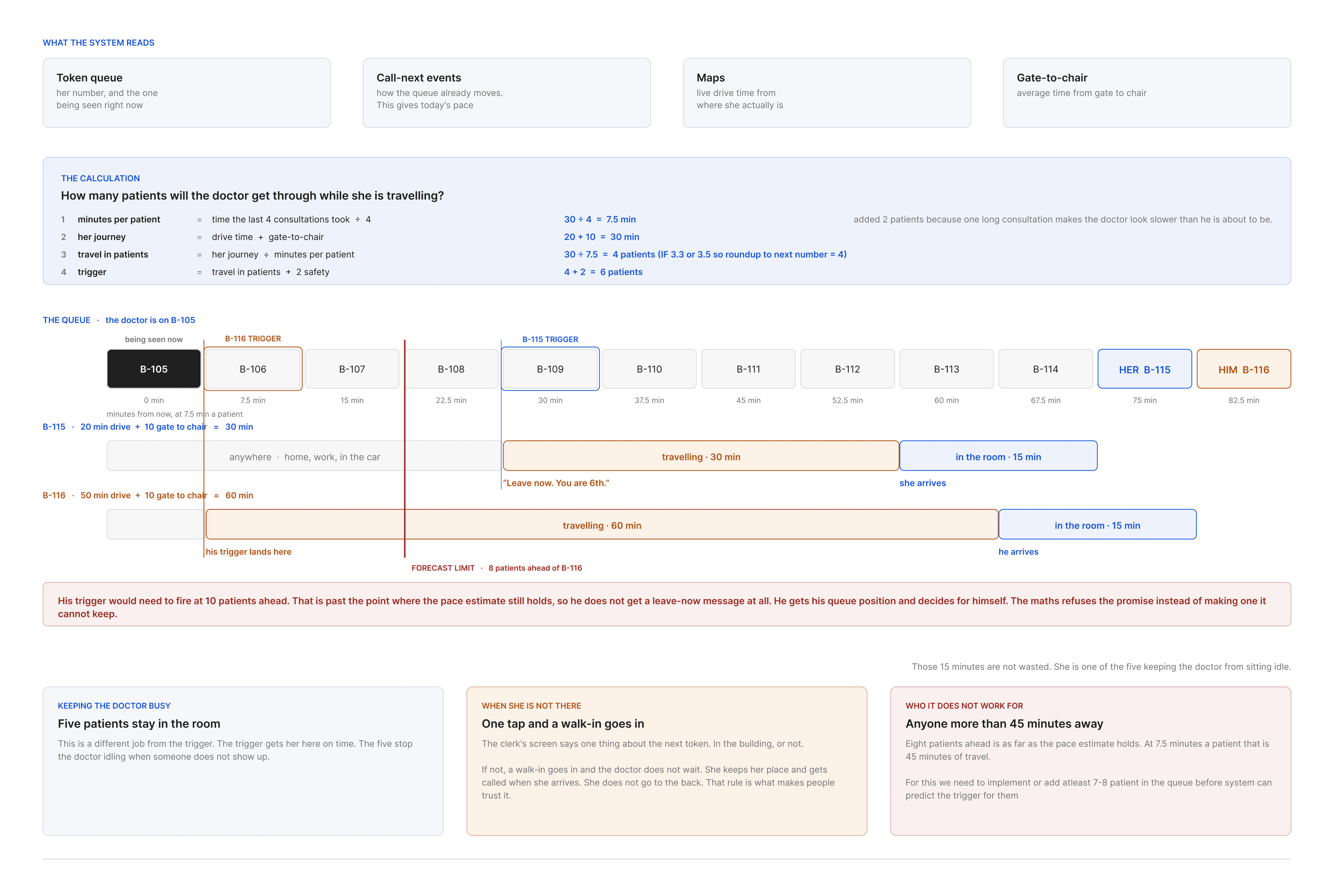
Dispatch on position, never on a clock time.
When a doctor finishes and nobody is in the room, the scarcest resource in the building is wasted. Patient waiting is annoying; doctor idling lengthens the queue for everyone behind. That is why restaurants can page you and clinics mostly cannot — and it is the constraint the whole model is built around.
Two valves on one pipeline: keep Present topped up to a target size by promoting from Staged, and keep Staged populated from Holding. The intelligence is in the buffer, not the algorithm.
- 01Minutes per patient — today's pace
The rolling time of the last few consultations, from call-next events the console already records. Not last month's average: this doctor, this session. 30 ÷ 4 = 7.5 min.
- 02Her journey — door to chair, not door to door
Live drive time from where she is, plus gate-to-chair: the barrier, the space, the lift, the corridor. No API knows that last leg; it is measured once per entrance, per zone. 20 + 10 = 30 min.
- 03Travel in patients
Her journey divided by today's pace, rounded up. 30 ÷ 7.5 = 4 patients.
- 04The trigger
Travel in patients plus two for safety — because one long consultation makes the doctor look slower than he is about to be. 4 + 2 = 6: “Leave now. You are 6th.” The margin is deliberately lopsided: early costs a short sit-down, late costs the turn.
Come when you are told, and you keep your place. The hospital made the prediction, so the hospital carries the cost of being wrong.
- 01Booked
“You are 4th in the 9:00 group. We will message you when the doctor starts, and again when it is time to leave. Do not come early — you will not be seen sooner.” That last line does the real work.
- 02Doctor started
“Dr Rao has started, 38 minutes late. You are 4th.” Not bad news — the most valuable message in the system, and it needs no tracking at all.
- 03Holding
“You are 12th. Usually 50–70 minutes from here.” A range, never a point. A single time is a promise; a range is information.
- 04Leave now
“Time to leave. You are 6th. About 22 min drive, plus 12 min from the gate to Zone 7.” Naming the gate-to-chair leg is what stops someone leaving twelve minutes late.
- 05Slipping
“Traffic is heavier than expected. You will be called when you arrive, within about 15 minutes.” The hardest message — it says what happens to her place without being asked.
The clerk already does this, badly, under pressure.
Walk into most OPDs and the clerk is doing a version of this by phone when the person at the front is missing: “Aap kahan ho? Aa jao, do number baaki hai.” Where are you — come now, two ahead of you. The behaviour is not new. What is missing is structure: today it happens only after someone is already absent, only for patients the clerk remembers, and only when they have a free hand.
So the screen that matters is not the patient's. It is the desk: in the building · on the way, with minutes · not called yet — and one new button, Pause clinic. If a clerk cannot see who is present, they call only the faces in front of them, and the queue order becomes fiction.
- 01The doctor is called to a ward mid-session
Everyone travelling is now travelling to a stopped clinic. The clerk taps Pause, and everyone en route is told at once, with an honest “we do not know yet”. Silence is what people never forgive — you are the reason they are in a car.
- 02Two follow-ups in a row take four minutes each
The corridor empties faster than anyone can arrive. This is the real reason five people sit in the room, and why patients who chose to wait on site are called first.
- 03The lift is out
Gate-to-chair for the second floor goes from twelve minutes to twenty. One toggle at the front desk adds that time to every estimate for the building.
- 04Phone on silent at the bottom of a bag
The most common failure and the least technical — why leave-now goes out with a wide margin, repeats once, and the clerk still has a number on screen.
- 05No signal in the basement car park
The message has to reach her before she goes underground. The design never depends on reaching someone who has already arrived.
- 06She comes at 8:45 out of habit anyway
Nothing happens to her. She waits, as today. The feature has to be worth having when only two people in twelve use it — for the first month, that is the situation.
- 01The benefit shrinks with distance. Five minutes away gains about 40 minutes; twenty-five minutes away gains about 20; fifty minutes away gains nothing. The people who gain most are the ones for whom the trip was cheapest.
- 02Duty of care transfers. Opt-in only, never the default. Anyone clinically urgent never enters dispatch. Every message carries “if you feel worse, come in now or call this number”.
- 03Parking falls, but gate flow rises. Arrivals cluster around call times instead of smearing across the hour — so the barrier and drop-off lane see sharper peaks. Measure both.
One message takes back most of the morning.
- 01Week 1–2 · replay a real day
The hospital already has arrival times, call times and consultation lengths. Run the dispatch logic over a month of history at different buffer sizes and measure the doctor idle time it would have produced. If the buffer has to be five or more, the feature is weaker than it sounds — and you find out for free.
- 02First · position and delay, no tracking
“The doctor has started, 38 minutes late, you are 4th.” No GPS, no dispatch, no promise. She decides. It takes back most of the wasted morning and tells you how many people act on information without being instructed.
- 03Then · leave-now for people already close
Car park, canteen, the road outside. Short distances mean small margins and almost no risk — and it is where most of the waiting actually is.
- 04Last · leave-from-home with live travel time
Only once the first two have run long enough that people believe the messages, and only for clinics whose sessions have proved predictable.
If sessions start unpredictably late rather than consistently late, the honest product is only the first row: tell people what is happening, and let them decide.
- 01Doctor idle minutes per session — the one number that must not rise. If it does, everything else is irrelevant.
- 02Advised time against actual arrival — whether the forecast and margins are honest.
- 03Share who ignore dispatch and come early — the trust curve. It will start high.
- 04Waiting-room dwell, car-park peak and gate flow — the thing being bought, and the thing it can quietly make worse.
What I would verify in week one.
- 01Peak lot occupancy, counted across a full week, split staff and visitor — this one can invalidate the largest call I made.
- 02Door-to-consult time and total dwell, and the attendant-stay rate.
- 03Lab completion against orders placed here, and repeat visits within 30 days — both already queryable in the HIS.
- 04Which events this HIS actually emits — the first integration question, and the one live status depends on.
- 01How late do sessions actually start? Scheduled start against first token called, three clinics, one week.
- 02How long is gate to chair? Walk it, once per entrance, per floor. A morning with a stopwatch.
- 03How spread out is consultation length? Follow-ups against new cases, from call-next timestamps that already exist.
What I could not find, and will not fake: no Indian data linking unprepared arrival to repeat trips, no parking occupancy data for a hospital of this profile, no baseline for slot slippage.
Sources.
- 01Synmon B et al. A study on patient waiting time in neurology OPD of a tertiary healthcare centre and its association with patients' demographic profile. International Journal of Science and Technology Research Archive. 2022;3(2):82–88. n=80. Mean waiting 110.86 min; mean consultation 5.34 min. IJSTRA ↗
- 02Acharya A, Kendre V, Jadhav Y, Tambe M. Association between waiting time, service time and patient satisfaction in the out-patient department of a tertiary care hospital in Maharashtra. Int J Community Med Public Health. 2023;10(8):2813–2820. n=80. IJCMPH ↗
- 03Sharma N, Aggarwal AK, Arora P, Bahuguna P. Association of waiting time and satisfaction level of patients with online registration system in a tertiary level medical institute outpatient department (OPD). Health Policy and Technology. 2022;11(4):100687. Health Policy and Technology ↗
- 04Ramjee P, Sachdeva B, Golechha S, Kulkarni S, Fulari G, Murali K, Jain M. CataractBot: An LLM-Powered Expert-in-the-Loop Chatbot for Cataract Patients. arXiv:2402.04620. arXiv ↗
- 05Hallsworth M, Berry D, Sanders M, Sallis A, King D, Vlaev I, Darzi A. Stating appointment costs in SMS reminders reduces missed hospital appointments: findings from two randomised controlled trials. PLOS ONE. 2015;10(9):e0137306. PLOS ONE ↗
- 06Jamshidi S, Hashemi S, Tran D-M T. Costs and effects of ineffective wayfinding in US hospitals: a survey of hospital staff. HERD. 2025;18(2):259–275. n=301. HERD ↗
- 07National Health Authority, ABDM Scan and Register service: 25 crore OPD registrations at 30,800 facilities. Announced August 2026; as reported by ANI, 7 August 2026. ANI report ↗
What this taught me.
The instinct was to build three features for three complaints. The work was refusing to — and finding the one thing nobody in the building owned.
The same question decided every part of it: what does this piece of the system actually know at the moment it has to speak? It is why the wall carries zones and not steps, why the board says “in progress” instead of a guess, and why the leave-now message counts patients instead of promising a time. And it is why part two's best feature is the humblest one — telling people the doctor is late.
A design study, not a shipped product. Claude was used to locate and screen published research, to check citations, and to pressure-test the framing and prioritisation. The demand model, the prioritisation, the cut list and the design decisions are mine.